
Publications

Different Paths of Pandemic Protection
Getting Canadians immunized against COVID-19 has been a complicated process in a country that has neither the capabilities to produce its own vaccine nor a centralized healthcare system to administer it.

Climatetiveness
What it takes for Canada to thrive in a net zero exporting world

Sequencing the Crisis
As COVID-19 surged through Canada’s population, the country’s genomics community came together in an ambitious national consortium to sequence the genomes of the virus and Canadians exposed or affected. Its challenging work didn’t stop there. Mary Gooderham recounts how it was done.

Future Proof
What public policy measures are needed to ensure that Canada’s digital connectivity infrastructure fully supports an inclusive, competitive post-pandemic economy?

Capturing a Carbon Opportunity
If the climate challenge confronting Canada is evident, so too is the economic opportunity out there to be captured. The twin objectives are clear and measurable: We must meet our 2030 GHG emission reduction targets on the way to a net-zero future by 2050, and we must do it in a manner that ensures jobs, growth and a strong economy. The good news is that a sightline to that future – one where a national carbon management strategy is critical to meeting our objectives – is coming into clear focus.

Toward a National Adaptation Strategy
The Public Policy Forum convened a roundtable discussion on June 16, 2021, to look at the development of a national adaptation strategy in Canada that spans disaster risk reduction and climate adaptation domains. The participants represented a range of public- and private-sector perspectives on the key challenges that need to be addressed to push towards greater resilience and adaptation and confront the challenges of climate change. The conversation also looked at the need to set clear time-bound targets and performance measures and ensure these are grounded in Canada’s Emergency Management Strategy.
Let’s build a better Canada together. Whether you’re looking to support our mission by becoming a member, partnering with us on a project or sponsoring an event, your engagement helps drive informed, inclusive policy across the country.
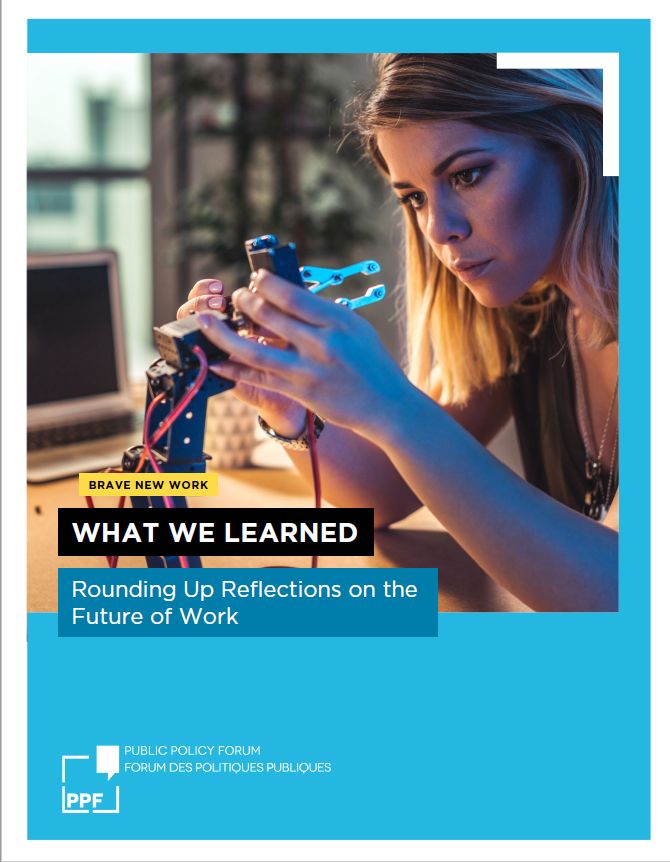
What We Learned: Brave New Work Round Up
PPF's flagship Brave New Work project is wrapping up by rounding up the perspectives and insights of over 20 of the people who contributed to the project over the years. We ask them what they learned about the future of work, and what they recommend needs to be done next.

Report 6: Three Areas in Which Pandemic Management Could Have Been Better
Members of Canada’s political class should on balance receive at least a passing grade for their management of the pandemic, and Canadians should be both proud and worried about policymakers’ performance during the COVID-19 pandemic. The three areas in which they could have done better include: keeping schools open, using technology to combat the pandemic, and prioritizing vaccine targeting.

Frontiers and Borders: The Internet and the Amplification of Illiberalism
"Truth is an inescapable foundation of the liberal order and is in a precarious state in today’s liberal democracy. Our ability to address difficult issues such as climate change or electoral integrity is compromised if truth and public opinion become confused.” Edward Greenspon’s recent essay examines liberalism’s complex state of flux in an age of internet dominance. Greenspon draws on his firsthand experiences as a journalist covering the ascent of liberalism in the late 1980s and early 1990s, using it as a jump-off point for considering the ongoing struggle between the frontiers of change and social progress versus the borders of insecurity and social stability.

We Want Real Partnership
In April 2020, the Energy Future Forum convened a plenary session on the critical importance of the United Nations Declaration on the Rights of Indigenous Peoples (UNDRIP) and full Indigenous participation and ownership in Canada’s energy development. The following is a blended transcript edited for clarity and conciseness of Indigenous economic leaders Alicia Dubois, Tabatha Bull, Mark Podlasly, J.P. Gladu and Kim Baird. These leaders spoke about their vision for economic reconciliation, the challenge of access to capital and the opportunity UNDRIP presents to catalyze economic development by making real partnership a prerequisite for any project to move forward in Canada.

Rhetoric vs. Results
Canada’s standard of living has been slipping: Between 1945 and 1976, parents could expect that their children would make twice the salary they did but today’s parents would be waiting 400 years for that to happen. Despite a professed desire to help the middle class, governments have done very little to do so; they fail to address this issue at their peril. This paper by PPF Fellow Don Wright provides several ways to fix the problem.

Automation, AI and COVID-19
A majority of Canadians indicate they have at least a basic understanding of AI and automation. Politicians have an opportunity to seize upon this perceived knowledge to address coming challenges by linking COVID-19 solutions to challenges — and potentially positives — presented by AI and automation. This new report by Peter Loewen and Blake Lee-Whiting shows signs that Canada has not seen a large populist backlash to the pandemic, but that could be coming, perhaps against immigration policies, if citizens feel the government is not following through on job creation.

Frontiers and Borders:
The Internet and the Amplification of Illiberalism

Managing Transformation in Disrupted Sectors
There are lessons to be learned from industries that have survived and thrived through disruption, as well as those that have failed to navigate industry transformation. We need to learn from the past while we look for innovative ways of working together to rebuild the economy. To achieve these goals, we need to plan for inevitable change as all sectors, no matter how resilient writes Lori Turnbull. With the right tools, workers, employers and sectors can fortify themselves in a new economy.

Supporting Entrepreneurship and SMEs: A Post-Pandemic Skills and Training Agenda
The impact of COVID-19 on small and medium-sized enterprises (SMEs) has been significant and severe. SMEs are the backbone of Canada’s economy, yet few have the resources to deal with the skills and labour shortages they face – shortages that the pandemic has only made worse. By combining preliminary data from an ongoing survey of SMEs, associated focus group discussions, and existing research, this report highlights opportunities to better support SMEs in the pandemic recovery and after. This includes a specific focus on embracing diversity and inclusion as a key way of addressing their skills needs.